
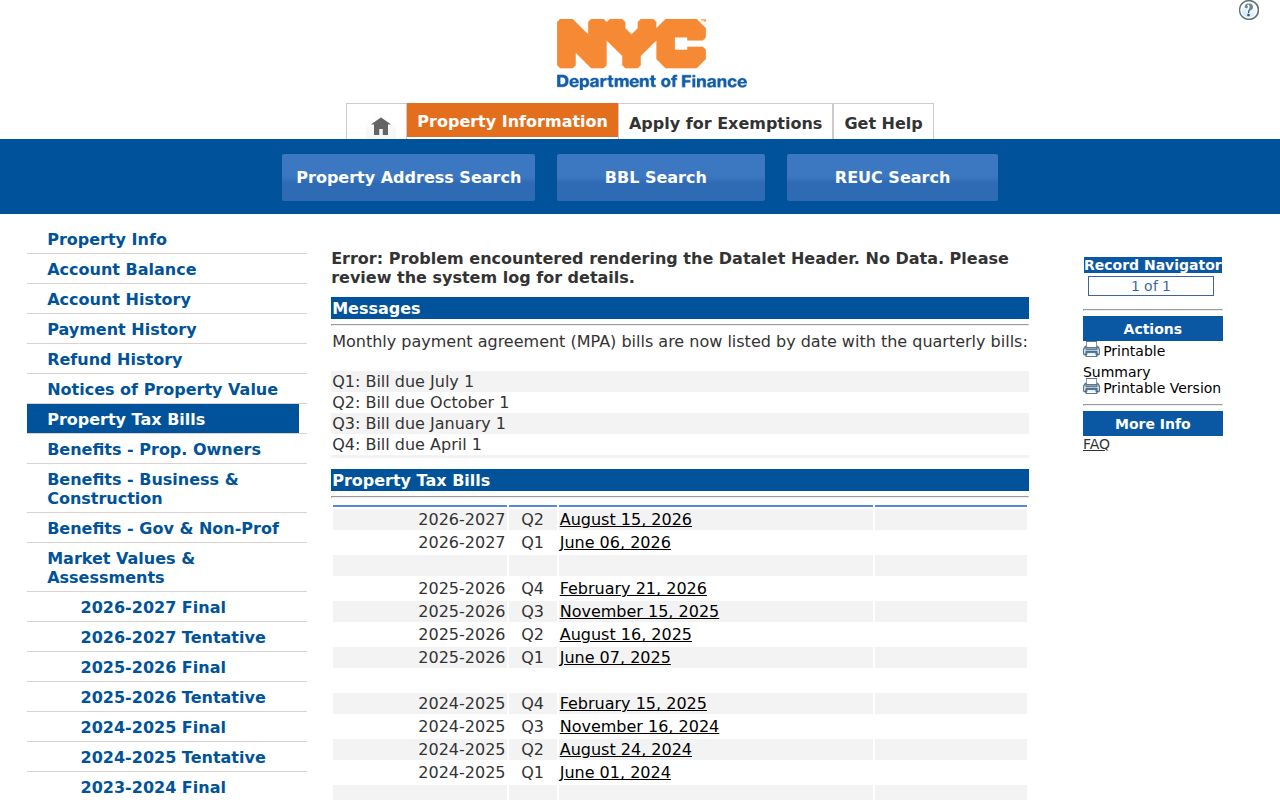
The official DOF account page shows annual bill and account navigation beside parcel data.
Use the assessment card and recorded deed to distinguish assessed value from sale consideration.
The Values on a Richmond County Property Record
Richmond County official record details
| Value | What It Is | Where |
|---|---|---|
| Assessed value | Richmond County official record details | Richmond County official record details |
| Market / appraised value | Richmond County official record details | Richmond County official record details |
| Last sale price | Richmond County official record details | Richmond County official record details |
| Land vs improvement | Richmond County official record details | Richmond County official record details |
Richmond County official record details
Looking Up a Richmond County Property Value
Richmond County official record details
- Richmond County official record details
- Richmond County official record details
- Richmond County official record details
- Richmond County official record details
- Assessed value
- Richmond County official record details
- Market / appraised value
- Richmond County official record details
- Level of assessment
- Richmond County official record details
What a Richmond County Assessor Value Is Not
Richmond County official record details
Value vs price. Richmond County official record details
Three Richmond County Value Numbers
A Richmond County property value is rarely a single figure. The Department of Finance publishes a market estimate, an assessed amount, a taxable amount after exemptions, and the consideration stated on a recorded deed. Each number answers a different question. To search Richmond County property records by address, start by pinning down the borough-block-lot and the year. Then trace the assessment history and read any exemptions separately. Finally, confirm the sale context in the deed records. None of these public figures equals a professional appraisal or a guaranteed sale price.
| Value type | Meaning | Where recorded |
|---|---|---|
| Market value | DOF estimate for assessment | PIP and assessment roll |
| Assessed value | Value after the class assessment level and rules | Assessment detail |
| Taxable value | Amount after applicable benefits | Roll and tax account |
| Last sale amount | Consideration tied to a transaction | Sales card and deed |
Richmond County Assessment Levels
New York City applies a 6 percent assessment level to tax class 1. Classes 2, 3, and 4 sit at 45 percent. Caps and transitional assessment rules can slow how quickly the assessed figure moves, which is why it may climb on a schedule that ignores any single year's market estimate. Before applying a ratio to a parcel, confirm the property's tax class first.
Look Up Assessed Value in PIP
Search the Staten Island address and select the exact lot. Save its borough 5 BBL for every later step. Open the assessment card and note the tax year. Note the market value, actual or transitional assessed value, and taxable value too. The ten-year assessment history shows the full sequence, which beats comparing isolated years. Finish by checking exemptions. They can shift taxable value while leaving the market estimate untouched.
- Resolve the BBL.
- Open the assessment detail.
- Record the fiscal or tax year.
- Compare the history table.
- Read benefits and exemptions separately.
Why Taxable Value Differs From Assessed Value
Exemptions shrink the portion of value that tax is computed on. Abatements work differently, usually reducing the tax itself through a separate mechanism. Two parcels can therefore carry identical assessed values. Yet those same parcels can produce different taxable amounts. For bills, charges, credits, payments, and interest, the tax account remains the authoritative source.
Find a Richmond County Recorded Sale Price
PIP's sales card can display transaction leads, including a document amount, but the Richmond County Clerk record supplies the deed context that gives the number meaning. Read the parties, the document type, the consideration wording, and any related filings. Family transfers, fiduciary deeds, partial interests, nominal consideration, and combined transactions can all make a recorded amount a poor gauge of open-market value.
The Annual Richmond County Valuation Cycle
The cycle runs on a calendar of its own. January 5 is the status date. A tentative Notice of Property Value follows in mid-January. The fiscal year begins in July. The fiscal year 2026 roll reflected activity through January 5, 2025. The next tentative roll appeared in January 2026. Values are revised every year. Always state the year and the inspection date when quoting a figure.
Property Value Data Is Not an Appraisal
Assessment data exists for taxation. A sales record describes one transaction. Neither captures current condition, interior improvements, financing concessions, or the full range of comparable sales the way a professional appraisal can. Map data carries its own vintage and is never a survey.
Value limit. A Richmond County assessed value is not a promise of what the property would sell for, and this lookup is not an appraisal.
Ten Years of Richmond County Assessment History
PIP's documented assessment history lays out a ten-year series covering market, assessed, and taxable figures. Read across the same field and the same fiscal-year basis. A jump can follow annual valuation or construction. It can also follow a class change, an exemption change, lot action, or a correction. The table alone will not name the cause. Compare building, exemption, and tax-map records before concluding anything. Save the page date, because a new roll can shift the visible range. For an appeal or a historical calculation, use the archived roll and notice for the specific year rather than a current summary alone.
Recorded Amounts Need Richmond County Context
A deed amount is a useful sale clue, nothing more. The instrument may cover a partial interest. It may be a related-party transfer, a fiduciary conveyance, or several parcels at once. Read the deed, the transfer details, the parties, and the BBLs. Confirm that both figures describe the same interest and date. Then you can compare an ordinary sale with the assessment estimate. Market conditions can shift after the recording date. Physical condition may also stray from public administrative data. A defensible present value may be required. A licensed appraiser can then analyze current condition and comparable sales.
Date Every Richmond County Value Figure
Every value figure needs a label. Record the value type, fiscal year, BBL, portal inspection date, and source card. For a sale amount, add the deed date, document type, parties, and transaction context. For an assessment, note the tax class, the exemptions, and whether the figure is market, assessed, transitional, or taxable value. Without those labels, two perfectly correct numbers can look contradictory. With them, the public record becomes a transparent history of administrative valuation and transactions, while present market appraisal stays the work of a licensed professional.