
The Richmond County Clerk land search is the place to begin any hunt for recorded Staten Island instruments.
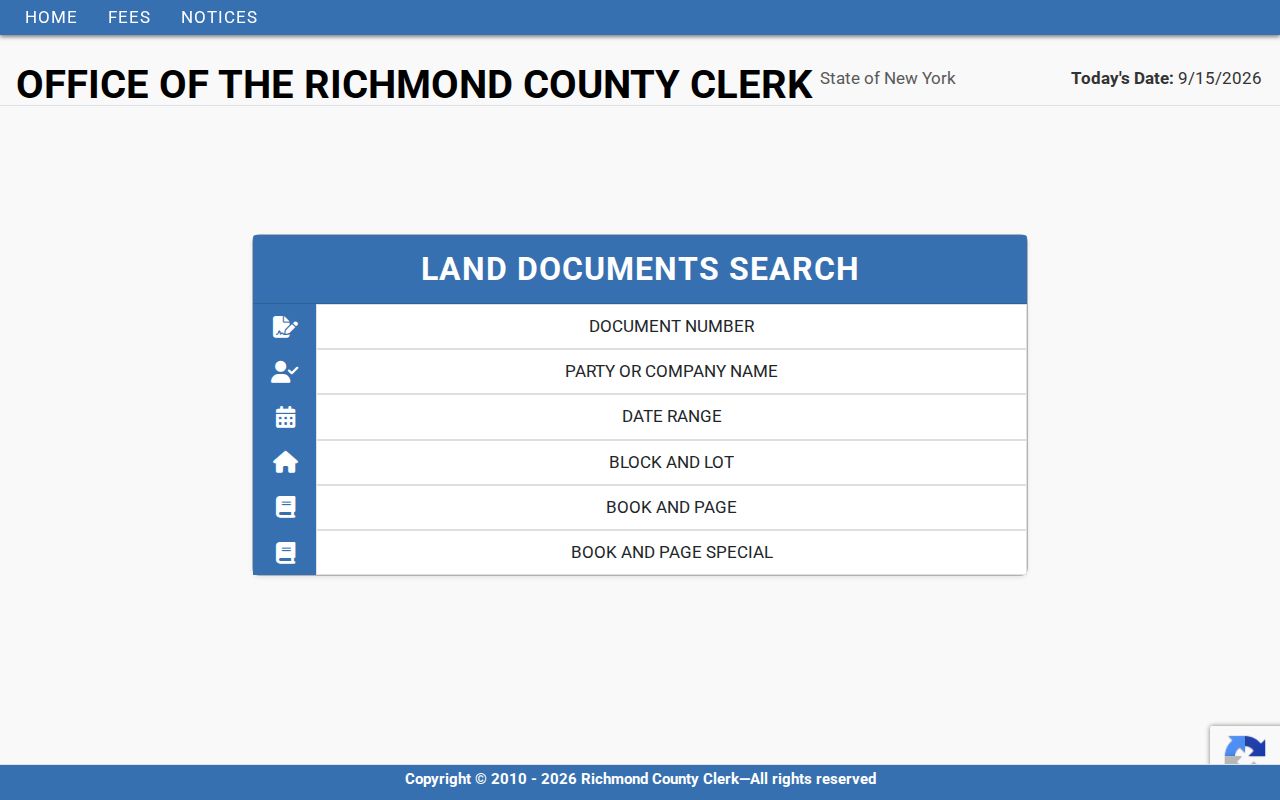
Use the result identifier to preserve a repeatable route to the instrument.
Richmond County Deed Records and What They Show
Richmond County official record details
| Deed Type | What It Does | Common Use |
|---|---|---|
| Warranty deed | Richmond County official record details | Richmond County official record details |
| Quitclaim deed | Richmond County official record details | Richmond County official record details |
| Grant / special warranty | Richmond County official record details | Richmond County official record details |
| Trustee / executor deed | Richmond County official record details | Richmond County official record details |
| Tax deed | Richmond County official record details | Richmond County official record details |
Richmond County official record details
The Richmond County Grantor-Grantee Index
Richmond County official record details
- Richmond County official record details
- Richmond County official record details
- Richmond County official record details
- Richmond County official record details
- Grantor
- Richmond County official record details
- Grantee
- Richmond County official record details
- Chain of title
- Richmond County official record details
- Book/Page vs Instrument #
- Richmond County official record details
Getting a Copy of a Richmond County Deed
Richmond County official record details
Recorded, not guaranteed. Richmond County official record details
Why Staten Island Deeds Use the Richmond County Clerk
Richmond County breaks the pattern. Unlike the other boroughs, Staten Island land records rest with the Office of the Richmond County Clerk and County Register, not the citywide ACRIS system most tutorials describe. Its public search lets you look by party or company, block and lot, document type, date, or book and page. City finance pages can hand you a BBL or a recording lead. The county index and the recorded image are what actually confirm the instrument.
The office sits at 130 Stuyvesant Place, second floor, Staten Island, open weekdays from 9:00 a.m. to 5:00 p.m. When historic books, odd indexing, corrections, or certified copies come up, the counter is the fallback. It also serves records that will not render online.
Read a Richmond County Deed Result Carefully
A parcel result typically lists the block, lot, and recording date. It also shows the document type, document identifier, and a link to details or an image. Open the record itself. Never trust the result label alone. Inside, confirm the grantor and grantee, the execution and recording dates, and the legal description. Check the consideration language and references to prior instruments. Save the identifier, too. The live search is being modernized, and a saved route may change.
| Instrument | What it may show | What it does not mean |
|---|---|---|
| Deed | A transfer to a grantee | Automatic proof of a clear title |
| Mortgage | A secured debt | A new owner |
| Satisfaction or release | An encumbrance was discharged | Every lien is cleared |
| Lis pendens | Pending litigation affects the parcel | A final judgment |
| Easement | A stated property right | A boundary survey |
Walk Richmond County's Grantor-Grantee Chain Backward
Start with the most recent deed that looks like the current ownership. Note its grantee. Search that name as a buyer. The goal is to find the deed by which they acquired the parcel. On that earlier deed, the seller becomes your next target. Keep repeating the pattern backward, checking legal descriptions and parent lots as you go. That discipline keeps a same-name stranger or an unrelated parcel out of your chain.
- Resolve the current borough 5 BBL in PIP.
- Find the newest deed for that block and lot.
- Copy the grantor, grantee, date, identifier, and legal description.
- Search the grantor's earlier acquisition as a grantee.
- Compare book, page, abutters, dimensions, and map history at every step.
Pre-1966 Staten Island Deed Records
Older Staten Island land research heads back to the Richmond County Clerk. Official New York City guidance itself directs researchers there. The county has recorded since 1683. That means a deep chain may pass through lettered or numbered grantor, grantee, mortgagor, mortgagee, and lis pendens indexes. FamilySearch's New York Land Records collection spans 1630 through 1975 and can offer image-browse leads. Availability and access may vary there. Treat it as a companion rather than a substitute.
Historic address warning. The 1898 consolidation, street renaming, subdivisions, and lot changes can separate an old deed from today's address. Use the legal description, abutters, book and page, and tax-map history.
Mortgages, Liens, and Releases in Richmond County
A deed chain alone is half the picture. Pair it with encumbrance research. Search Richmond County mortgages under borrower and lender names, then chase assignments and satisfactions. Run liens and releases with whatever names and property identifiers you hold. A notice of pendency signals litigation and belongs in the court docket, not the deed records. It is not the outcome itself. For many Richmond County Supreme Court matters, NYSCEF and WebCivil Supreme offer public case-search routes.
Copies, Alerts, and the Limits of a Deed Search
Certified copies follow the clerk's current process and statutory charge. Confirm the fee before ordering rather than assuming a universal one. New York City's Notice of Recorded Document service takes an address or BBL plus registration details. It then notifies an owner of later recordings. Staten Island deed-fraud guidance likewise points back to the Richmond County Clerk.
A deed index has limits. It cannot reveal every unrecorded claim. It cannot cure a defective instrument, settle a boundary, or insure title. For a purchase, litigation, or inheritance dispute, bring in a qualified New York title or legal professional. For ordinary house history, keep the image, the index citation, and the search date. Another researcher can then repeat your path through the property records.
Richmond County Deed Search Fields and Fallbacks
Match the search field to what you know. Use party or company search when a grantor or grantee is named, block-and-lot search when the parcel is known, and document or book-and-page search when a citation is in hand. Try punctuation, suffix, initial, trustee, estate, and company-name variants. If an online result is missing or an image will not load, take your search log and citation to the clerk counter. The office can steer you to older indexes and explain the current copy process.
Historic searches reward patience with old details. Preserve former lot numbers and local place language. A legal description, an abutter, or a parent tract can link a deed that a modern address search cannot reach. The New York State Archives land-record pathfinder and the FamilySearch collection add finding support. The clerk remains the official Richmond County source.
Date and Preserve Every Richmond County Deed Finding
Log everything as you go. For each instrument, retain the exact party spelling and the party role. Also keep execution and recording dates, document type, BBL, legal description, document ID or book and page, image source, and inspection date. Before treating an older record as final, search forward for a correction, release, later deed, or court event. If the parcel changed over time, record both parent and child lots.
This audit trail matters twice over. The county search interface is being modernized. Historic material may live in a different index or image collection. A citation another researcher can repeat beats a copied name stripped of its deed context every time.
Always separate the index entry from the recorded image, and the recorded image from a legal conclusion about title.