
The County Clerk party search supports grantor and grantee work.
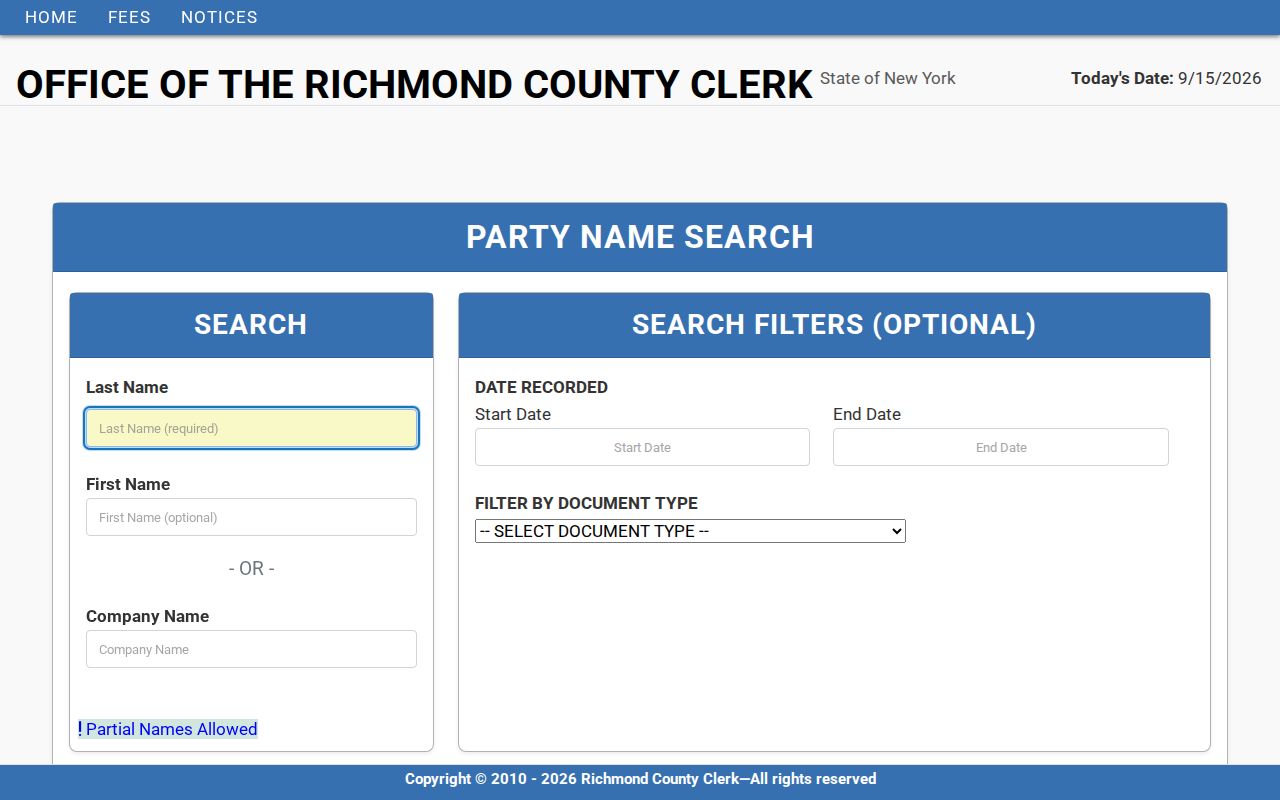
At every link in the chain, record the parcel's legal description so a same-name party cannot pull you onto the wrong lot.
Tracing Former Owners of a Richmond County Property
Richmond County official record details
| Source | Years It Covers | Where Held | What It Shows |
|---|---|---|---|
| Richmond County official record details | Richmond County official record details | Richmond County official record details | Richmond County official record details |
| Richmond County official record details | Richmond County official record details | Richmond County official record details | Richmond County official record details |
| Richmond County official record details | Richmond County official record details | Richmond County official record details | Richmond County official record details |
| Richmond County official record details | Richmond County official record details | Richmond County official record details | Richmond County official record details |
Richmond County official record details
Walking the Richmond County Deed Chain Backward
Richmond County official record details
- Richmond County official record details
- Richmond County official record details
- Richmond County official record details
- Richmond County official record details
- Grantor / grantee
- Richmond County official record details
- Chain of title
- Richmond County official record details
- Legal description
- Richmond County official record details
How Far Back Richmond County Ownership Records Go
Richmond County official record details
Lawful use. Richmond County official record details
Build a Richmond County Deed Chain Backward
Begin with the most recent ownership deed, never a remembered surname. Write down its recording date, grantor, grantee, deed type, document identifier or book and page, parcel number, and legal description. The grantor is usually your best former-owner lead. Search that party as a grantee to find the earlier acquisition. Then repeat the process, confirming at each step that every deed records the same parcel.
| Transfer date | Grantor to grantee | Deed type | Reference |
|---|---|---|---|
| Newest recorded conveyance | Seller to current grantee | Read instrument | Document ID |
| Prior acquisition | Earlier owner to later seller | Read instrument | Book/page or ID |
| Older link | Repeat in reverse | Check fiduciary role | Historic index |
Use the Grantee Index, Then the Grantor Index
A grantee index shows when a party acquired an interest. A grantor index shows when that party conveyed one. The reverse-chain method alternates between the two roles. Search married-name forms, initials, corporate predecessors, estates, trustees, referees, and punctuation variants, comparing the legal description at every link rather than trusting a name match.
Grantor: a party conveying an interest. Grantee: a party receiving one. Chain of title: the connected sequence of transfers, and a reverse index is arranged by the opposite party role for backward deed records research.
How Far Back Richmond County Ownership Records Go
The Richmond County Clerk's recording role goes back to 1683. Official city guidance sends pre-1966 Staten Island deed records research to the clerk. Do not assume ACRIS coverage for those years. FamilySearch's New York Land Records collection covers 1630 through 1975. It includes deeds, mortgages, grants, indexes, and images. Treat it as an archival lead. It is no substitute for clerk certification, and access can vary.
Online cutoff warning. Do not stop because a modern portal is blank. Older owners can require counter indexes, deed books, scanned volumes, or archival finding aids.
Colonial Books and the 1898 Translation Problem
An old Richmond deed may describe the land by farm, village, town, or road. It may also use shoreline or a neighboring owner instead of a street address. Consolidation in 1898 and later subdivisions changed local labels and lot numbers. Bridge the eras with abutters and courses and distances. Dimensions, parent-tract references, tax-map history, and book and page help too. Note both the old parent parcel number and its descendant lots.
Estates and Fiduciaries Can Break a Simple Chain
A death does not always produce an ordinary seller-to-buyer deed. Watch for executor, administrator, trustee, referee, or estate wording. Consult probate or court context when required. A quitclaim may transfer only whatever interest the grantor held. An assignment or mortgage is not a deed at all. Record each party's precise capacity. That way the next deed records search uses the name actually indexed.
Map Changes Explain Missing Prior Owners
A current lot can be the child of an earlier parent parcel. PIP Tax Map History posts map-change PDFs for the documented period since May 2008. Recorded plats at the clerk reach further back. A short chain under the present parcel number usually means the lot has a former identity. Find that earlier lot and search it. Historic tax maps, legal descriptions, and subdivision names can reconnect the ownership sequence.
What a Reverse Richmond County Chain Cannot Establish
A reconstructed list of previous owners can miss unrecorded interests, indexing errors, defective instruments, or probate rights that need legal analysis. It is house-history research, not title insurance. Preserve images and citations, and mark uncertain links clearly. When the conclusion affects a purchase, inheritance, or lawsuit, use a qualified title professional.
Directory Evidence Can Test a Richmond County Timeline
The 1933-34 Polk's Staten Island directory is held in the New York Public Library digital collection. It can add address and household context between deeds. The Staten Island Museum's ACEGen work serves a similar purpose. Municipal Archives vital and historical collections can help with a name change, death, or family link. Their access rules apply. These sources support a hypothesis. They do not transfer title.
Place directory entries beside deed dates instead of treating them as owners. A person can occupy or run a business at an address without holding the deed. An absentee owner may never appear in a local directory at all. The deed records remain the deciding evidence.
Keep a Source Ledger for Previous Richmond County Owners
For every proposed link, list the deed date, grantor, grantee, role, reference, legal description, parcel number or parent lot, and image location. Mark a link uncertain when the name matches but the parcel description does not. Search forward for corrections and releases. Search backward for the acquisition deed itself.
A ledger like this separates recorded ownership from directory occupancy, family tradition, or assessment administration. It also exposes gaps that need a clerk book, archival image, probate file, or professional title examination rather than a guessed former owner of record.